The Zoological Garden and the Museum of Natural Histor







Historical context
Longchamp park housed two scholarly institutions partially linked to imperial history: the Museum d’histoire naturelle (Museum of Natural History) and the Jardin zoologique (Zoological Garden). These two institutions, sworn to natural sciences, did not initially have any involvement with the colonial project. However, as the French Empire developed, the institution’s links with the Empire intensified.
At the beginning of the 20th century, exotic species that were presented to the public came largely from the colonies and fed a colonial imaginary. Today, the remains of the Zoological Garden, which closed in 1987, testify to that imaginary fueled by orientalism.
Palais Longchamp’s Zoological Park
The Zoological Garden was the zoological park of Marseille that opened in 1854. It was located within the gardens of Palais Longchamp and closed the 30th of December 1987. The idea to install a zoological garden on the grounds of Longchamp came during the creation of the gardens in 1854 but it was not until 1856 that the zoo was constructed. Originally occupying a surface of 5 hectares, the space was quickly deemed too small. The municipality decided to expand the garden above the boulevard Cassini.
Creation of the Zoological Society of Marseille by Jean François Mayor de Montricher (1854)
Montricher, the engineer of the canal of Marseille, took the lead of the project and created a society of shareholders on 18 April 1854 called the Société zoologique de Marseille (Zoological Society of Marseille). The group is unique because it is both a commercial company (the majority of the stockholders were from Marseille’s bourgeoisie) and a scholarly society (Lapommeraye brought his scientific expertise to the new society). The group is reminiscent of its counterparts in London and Anvers. The new society bought a vast amount of land in Chartreux. 31,650 square meters acquired for the considerable sum of 262,375 francs. The land was acquired from three private individuals Mr Mazel, Rougier, and Baquière. At the time of its creation the Zoological Garden Marseille was seen as a way of promoting and bolstering the organisation’s scientific reputation. They demonstrated their expertise both through the diversity of the gardens collection as well as through its breeding and acclimatization of exotic species processes.
« Et quel champ plus vaste, plus fécond, plus naïf et plus vrai que les jardins zoologiques en général, que le bel établissement de ce nom, dont Marseille est dotée, dans lequel, selon la métaphore toute orientale et si poétique de Féruck-Khan, ambassadeur de Perse à Paris, on peut parcourir, en quelques heures, les diverses contrées du globe caractérisées par les animaux et les plantes qui leur sont propres ! » (Bartélémy Lapommeraye, Revue de Marseille fondée et publiée au profit des pauvres, troisième année, 1857, Marseille,1857)
Like theaters, an opera, museums, or administrative buildings, the garden was part of the indispensable amenities of all large cities of the second half of the 19th century. Inspired by the theory of Hygienism, the gardens and parks were supposed to bring leisure and sanitation to the inhabitants of large urban centers, purifying the air and beautifying the space. The zoo was separated in two parts that were joined together by a little bridge that spanned over a boulevard. Throughout the zoo’s existence, its collection of animals was always significant. They had close to 2,000 birds of 1,250 different species, along with a dozen mammals, and some reptiles, amounting to a total of 2,450 animals.
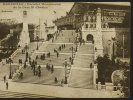
Jean François Mayor de Montricher was a polytechnician and an engineer of the corps of Ponts et Chaussées. He is famous for a number of projects in Marseille and around the region including the canal of Marseille and the aqueduct of Roquefavor. He linked the plateau to the zoo with a stairway that would later be doubled. The double stairway was placed framing the length of a waterfall that is reminiscent of the water tower of Palais Longchamp. This waterfall was also the living place of multiple bird species like ducks and flamingos. Throughout the zoo, cages that date back to 1899 are still visible, including cages for the bears, wolves, fawns, and birds. One can also still find various structures that were built to shelter the animals. These shelters were constructed in the style of the country of origin of the animal.
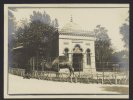
The Pavilion of the giraffe is constructed in a Moorish style, using cement as a decorative material. Constructed in 1858, it is the only building of the old Zoological Garden of 1854 whose construction date is known with certainty. This is thanks to the archives of the Société des ciments Désiré Michel & Cie (Society of cements Désiré Michel & Cie). The structure is square, covered by a dome with faceted sides according to the plans of engineer Henri Michel. On the main facade, a trilobed archway is accompanied by two windows with a horseshoe arch. A blue ceramic frieze highlights the archway and the corners of the pavilion.
In the spirit of the original construction, exact reproductions of the tiles were made by a ceramic craftsman from Aubagne within the context of the restorations on the giraffe and elephant pavilions in 2013. During the restoration of the giraffe pavilion, metalwork remains were rediscovered on the old windows.
The first giraffe was shown at the garden in 1864. Writing in Arabic on the pediment mentions the giraffe Zarafa, the Arabic word for giraffe. In 1872, an exceptional birth was recorded at the garden : a giraffe calf was put into the world. It is the second birth in captivity recorded in France. Unfortunately, the young animal passed away only three days after it was born. It was taxidermied by Pierre Siépo and rejoined the collections of the Museum of Marseille.
We can still see the buildings for the giraffe and elephant, as well as other smaller constructions that gave shelter to deer and antelope. Among the main species displayed in the zoo since its opening in 1856 until its closing in 1987 were:
- Asian elephant
- Giraffe
- Several species of ruminants (deer, antelopes, etc.)
- Ostrich and cassowary
- Ground tapir
- Big cats (lion, tiger, leopard)
- Many small carnivores (mustelidae, viverrids)
- Brown bear, polar bear
- Grey wolf
- Various bird species
- Various primates (lemurs, gorillas, monkeys, etc.)
Other animals that were occasionally displayed in a the zoo:
- Bottlenose dolphin
- Crocodiles
- Hippopotamus
Museum of Natural History of Marseille
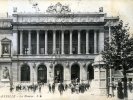
The Muséum d’Histoire Naturelle de Marseille was created in 1819 by Jean-Baptiste de Montgrand (often called « le marquis de Montgrand »), the mayor of the city from March 1813 to 1830, in collaboration with the Count de Villeneuve-Bargemon, the prefect. Prior to its definitive move to the right wing of the Palais Longchamp, the museum occupied different locations including the Chapelle des Bernardines. The Museum shares the Palais Longchamp, constructed by architect Henri-Jacques Espérandieu (1829-1874) in the 4th arrondissement of Marseille, with the Museum of Beaux-Arts. The city was the owner of animal remains of the zoo and therefore could supply both the natural history museum and the faculty of sciences. The Museum’s collections were significantly enriched over the years by the deaths of the neighboring zoo’s animals. A number of these taxidermied specimens are still on display in the museum. Thus, a taxidermied giraffe from the zoo arrived at the museum in 1873
Since the opening of the Zoological Garden in 1854, around 15 giraffes have succeeded in being acclimatized. However, the Zoological Garden of Longchamp did not expose any giraffes to the public of Marseille until 1864. The giraffe of Charles X, that passed through Marseille and travelled through France during the winter of 1826-1827 remains the most famous of the 19th century.
The zoo encountered chronic financial troubles very early on. In response, the municipality decided to take back the administrative control of the zoo from the Zoological Society of Marseille in 1863. Over time the zoo demonstrated itself to be the ideal complement to the Museum of Natural History. However, the financial troubles that the zoo of Marseille and the Zoological Garden faced during the 1980s resulted in their definitive closure in 1987.
Critical approach
The first European zoological gardens emerged at the very end of the 18th century for the very oldest and throughout the 19th century for the majority of them. The African territories, French Indochina (in 1887 consisted of Cochinchina, Annam, Tonkin, Cambodia and then Laos) was perceived very early on by Europeans as a preferred hunting grounds for sportsmen all over the world whether they be nobles, rich bourgeois, businessmen, explorers or scientists.
The indochinese tiger (Panthera tigris corbetti) was the emblematic figure of European fantasies of Asian nature and became the focus of amateur big game hunters. This “king of the forest”, locally called Ong Cop, was the subject of numerous hunts since the first military arrivals in Cochinchina in the 1850s, just like elephants, wild buffalo, gaurs, red deer or rhinoceros. Tiger hunts become an imperative of the “civilizing mission” against the threat that the tiger posed to the local populations and the settlers. The objective is also to domesticate the “savage” wildlife of the peninsula.
The interwar period was the golden age for sport hunting. Forest inspectors and professional guides such as Fernand Millet, the italian Honoré Oddéra or A. Plas organized tourist circuits for settlers and passing tourists. By the end of the 19th century these hunts were willingly encouraged by colonial authorities who established a system of kill bonuses for tigers that were deemed harmful to the crops and growers.
Until the independence of the Indochinese countries in 1954, safaris and tiger hunting, particularly in the high plateau and in forests, remained a central element in the establishment and functionment of French colonial order.
Authors
-

CHABANI Samia
Coordinatrice générale d’Ancrages, journaliste Diasporik
Bibliography
Lancelot Arzel, « Chasser le tigre en Indochine », in Colonisations. Notre histoire, Pierre Singaravelou (dir.), Seuil, 2024.
Christophe Borrely, « Histoire du Jardin zoologique de Marseille », Hypothèses, carnet de recherche, https://jzm.hypotheses.org
Christophe Borrely, « Une annexe méridionale d’un zoo parisien : la concession à la Société Impériale d’Acclimatation, 1877-1898 », 25 avril 2020, Histoire du Jardin zoologique de Marseille.
Pedro Lima, Anne Médard, Le Muséum d’histoire naturelle de Marseille, 200 ans de collections partagées, Synops, Ville de Marseille, 2021, tome 1, 80 pages
Pedro Lima, Anne Médard, Le Jardin zoologique, du parc animalier d’agrément aux collections du Muséum, Synops, Ville de Marseille, 2021, tome 2, 78 pages
Jules Siepi, « Petite histoire du Jardin Zoologique de Marseille », Annales du Musée d’histoire naturelle de Marseille, 1937, 28 (7), p. 5-11
Pierre Singaravelou, Professer l’Empire. Les « sciences coloniales » en France sous la Troisième république, Paris, Publications de la Sorbonne, 2011, 409 pages
Noël Suquet, Notes sur les autruches du Jardin zoologique de Marseille, Arnaud, Marseille, 1861, 20 pages
How to cite
(2026). “The Zoological Garden and the Museum of Natural Histor”, Mars Imperium (https://marsimperium.org/le-jardin-zoologique-et-le-museum-d-histoire-naturelle?), page consultée le 28 October 2026, RIS, BibTeX.