Imperial Statuary: the stairway of the Saint-Charles train station








Historical context
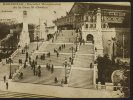
At the time of its inauguration in 1848 the Saint-Charles train station did not originally have a direct accessway to the boulevard Athènes. However, after abandoning the idea of a funicular tramway, elected officials decided that a stairway would connect the station to the city. In 1911, the municipality launched an appeal for its construction. Eugène Senès and Léon Arnal’s project proposal was accepted, but it was too expensive. A financial solution was found through a railway ticket tax, but the beginning of World War I delayed the project. Finally, an official agreement was made between the city and the State in 1923 allowing the construction to begin that same year. The work was finished in 1926 and the stairway was inaugurated by the President of the Republique Gaston Doumergue on the 24th of April 1927. Therefore, it was after the Colonial Exhibition of 1922 that travellers and the Marseillais would first be able to walk the stairs and view the statues that line it.
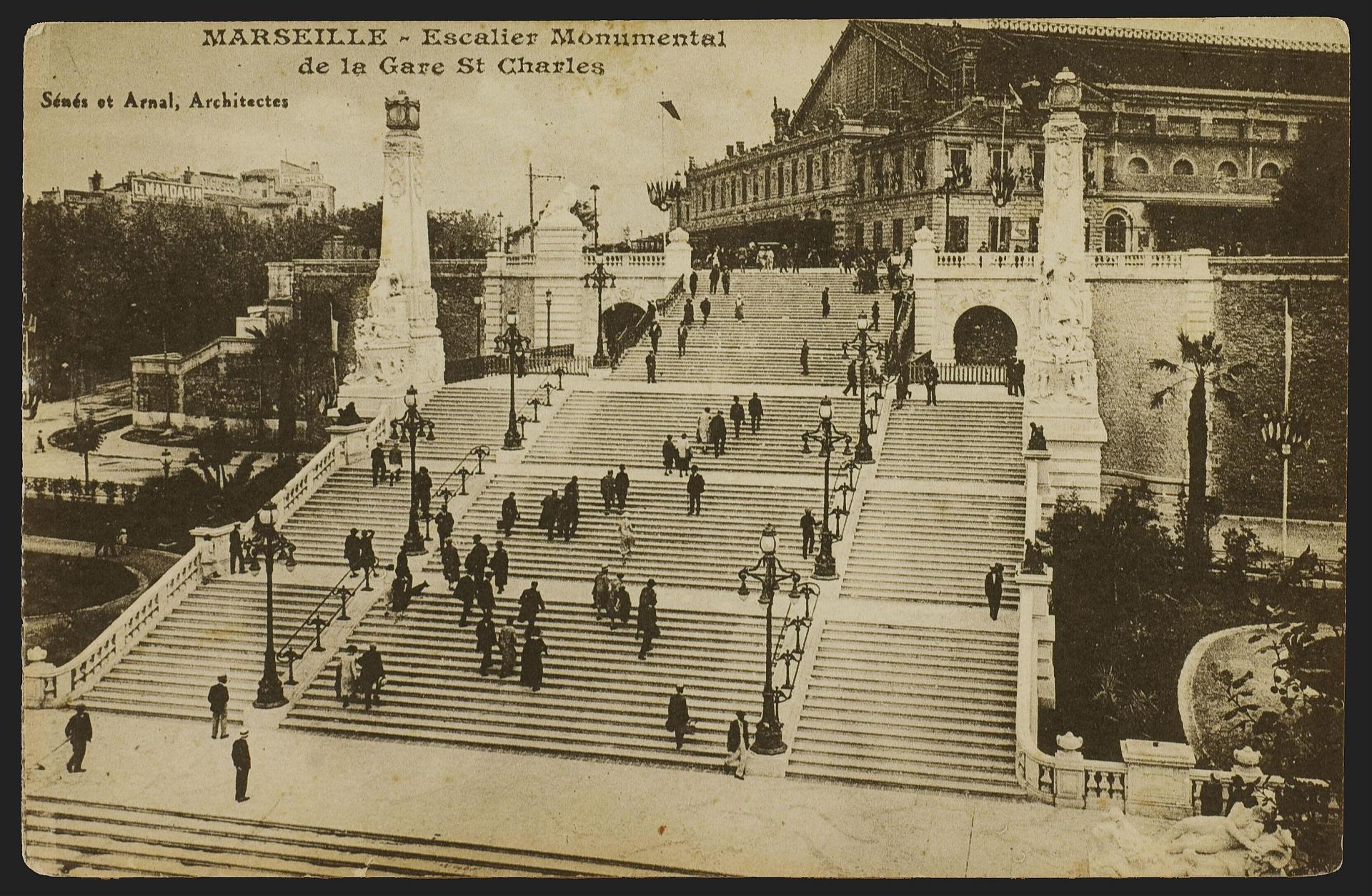
Made up of 105 steps and 7 landings, the Saint-Charles stairway was presented as an innovation within the urban landscape. Indeed, its framework is one of the earliest examples of the application of reinforced concrete. The cement came from the Chauffert brothers’ company, the Société coloniale des chaux et ciments Portland de Marseille (Colonial Company of Limestone and cements Portland of Marseille), which exported to all the colonies in Africa. In addition to the technical aspects, the monumental stairways quickly became the symbol of the Saint-Charles train station. While descending the stairway one can view an exceptional panorama of the city.
Critical approach
Summer 2021, the inscription “it is time to decolonize !!!” was affixed onto the base of one of the statues at the bottom of the Saint-Charles stairway. Since, the site has been the subject of various actions including collages, dance performances, inscriptions, and pasted posters that bring attention to the colonialist and sexist nature of the statues. The activist groups behind these actions are demanding, notably through petitions, the removal of the statues from public space. The two denounced statues represent France’s colonies in Asia and Africa. Asia is represented by a female figure who evokes a Khmer princess. Reclined on a pedestal, her chest is uncovered, the bottom of her body covered by a skirt. Adorned with jewels, her hair is styled, and her hand rests on the head of a lion carved in a style reminiscent of Khmer statuary. The figure is accompanied by a pair of children. One carrying a basket of fruit (8) and the second holding out a statuette.
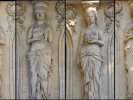
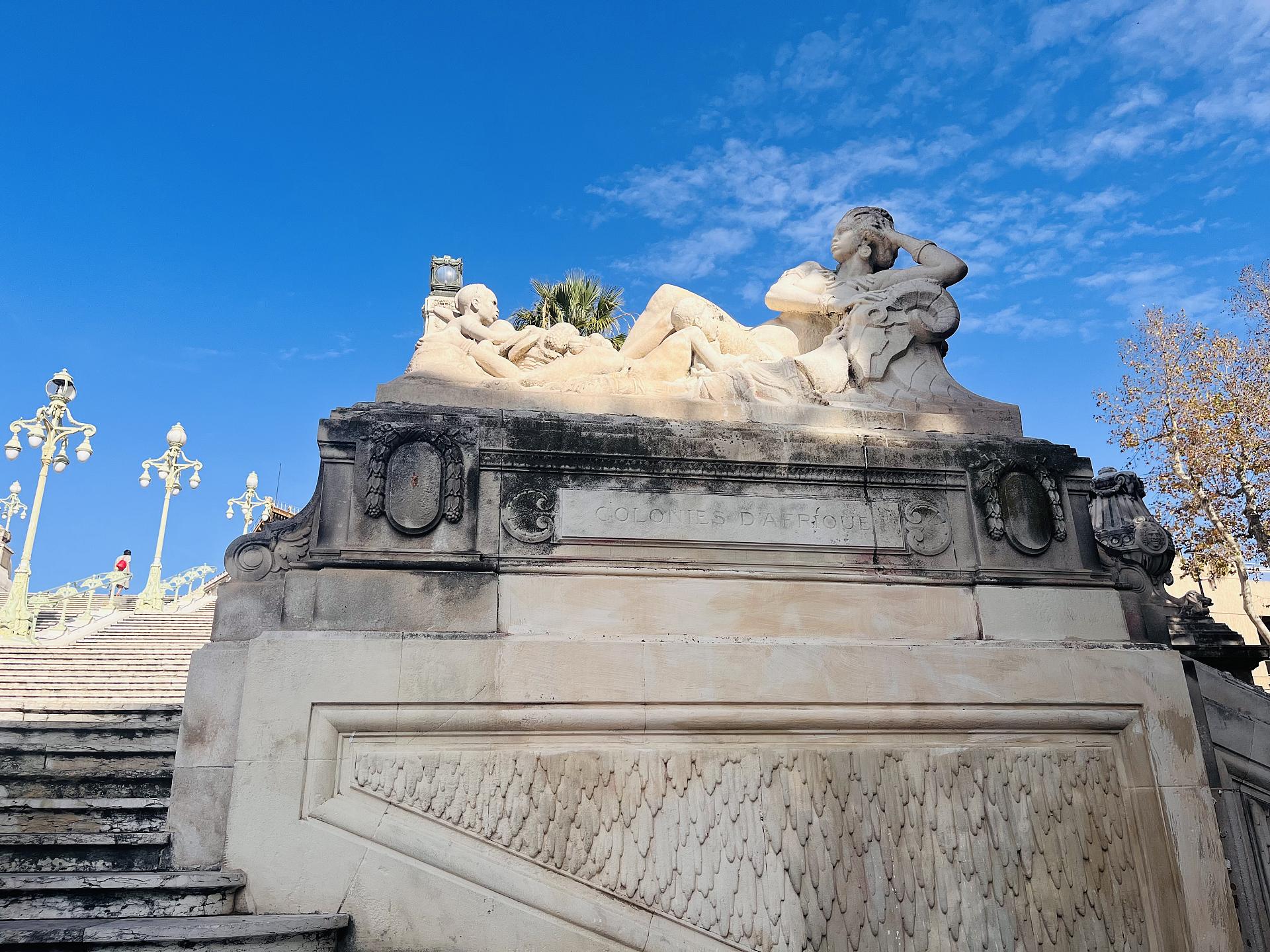
Across from and nearly symmetric to the first figure, is another woman, this time representing France’s colonies in Africa. She posed half leaning on the pedestal, the edge of which is a buffalo skull. The figure’s hair is styled in braids, she is naked, demonstrating her visibly muscular strength and her full chest. At her side are children who present her with fruit, a mask, an elephant’s tusk, as well as a monkey and its baby. Created by the sculptor Louis Botinelly, these statues make up the lowest level of the stairway. The construction of the stairway was decided in 1911 but the first stone was placed in 1923, and the monument opened in 1925. Within this window, the contexts had changed and Marseille had opened up more to the empire. The organization of the Colonial Exhibition in 1922 played a big role in the creation of the city’s image, as well as in the dissemination of imperial representations. These types of representations were already present in the urban landscape, demonstrated by the caryatids of the former hotel du Louvre et de la Paix on the Canebière. These caryatides are an allegorical example of the continents represented through an imperialist perspective that was inspired by ancient models.
The feminine groups by Botinelly subscribe to the same two influences. They refer to the classic representation in Antiquity of the “faithful or pacified provinces" of the Roman Empire represented through female allegories. The motif of a female figure resting horizontally refers to an allegory for rivers, which was reused to represent the provinces. The bare breasts and the presence of children cumulate with images of the nourishing earth. The elements around them refer to their origines.
The second influencing element is more contemporary. Regardless that the stairway to the Saint-Charles train station was not able to be constructed in time for the Colonial Exhibition of 1922, it undeniably bears the mark. The middle landing featuring the towers designed by Auguste Carli represent, here again, two female allegories with an obvious imperial dimension: Marseille, porte de l’Orient (Marseille, door to the Orient) and l’Orient et Marseille, colonie grecque (Orient and Marseille, greek colony). On the base of the structure, Asia to the east and Africa to the west, are pure archetypes of the racial stereotypes then in force. They also refer to a supposed hierarchisation of the diverse populations of the French empire. Asia is represented surrounded by objects from the Khmer civilisation, prestigious but disappeared. The image of a vase decorated with a frieze of Cambodian dancers resembles the vases that were made for the Colonial Exhibition in 1922. The register used for the colonies of Africa is more in the nature of animality. The representation of Asia also suggests a larger sense of modesty and a certain mystery, similar to other imperial representations. However, one notes the same lewdness, the same eroticization of female figures who are reduced to a confusing exotic imagery that draws from the vast store of colonial imaginaries.
Therefore, these statutes, the caryatids of the Hotel du louvre et de la Paix and the statues of Saint-Charles, diffuse the idea of a form of universal domination. This idea, based on ancient models, is reused along with other motifs at the time of contemporary French colonisation.
The statues that adorn the sides of the stairway form an ideological discourse with the urban space. The discourse is further developed and reinforced through the symbolic and functional power of the stairway. At the top of the stairway, on both sides, there are statues of two lions with children created by Ary Bitter. On the left side, an anchor with the inscription “the sun and the sea”, represents Marseille as an industrial port. The second statue group on the right side represents Marseille as a maritime business capital.
While descending the stairway one encounters two opposing feminine figures made by Auguste Carli. To the right, dressed in a short coat, Marseille “colonie grecque”. On the left side, Marseille “porte de l’Orient” holds a trident, the symbol of Poseidon, god of the sea. The statue’s harsh expression shows the strength and will power of Marseille.
Looking at the stairs from the train station the ideological apparatus of the era appears even more clearly. The descent of the stairway is also a narrative of history. Marseille, Greek colony by its foundation, linked to the Orient for more than 20 centuries, is naturally, historically, and legitimately presented as the capital of colonial France. Moreover, the discourse surrounding the civilizing mission of the colonial project is equally on display.
The complexity of the stairways remains in the fact that it is at the same time propaganda, a monument, and a used space. Its function still is to connect the city to the train station. Though there are other entrances, this remains the principal access. Today, the presence of colonial representations in public spaces incites discomfort and debate.
Authors
-

CHABANI Samia
Coordinatrice générale d’Ancrages, journaliste Diasporik -

STEFANI Matteo
Anthropologue
Bibliography
Georges Aillaud et al., Désirs d’ailleurs : les expositions coloniales de Marseille 1906 et 1922, Marseille, Ed. Alors hors du temps, 2006, 139 pages
Aurélia Dusserre, « L’escalier de la gare Saint-Charles, ou Marseille « porte de l’Orient » », in Pierre Singaravélou (dir.), Colonisations. Notre histoire, Paris, Seuil, 2023, p. 473-474
Catherine Marand-Fouquet, « Le genre des colonies. Sur les escaliers de la gare Saint-Charles », Clio. Histoire, femmes et sociétés, 12, 2000, p. 188-191
Gérard Monnier, « Deux chantiers de sculpture monumentale à Marseille en 1925 : l’escalier de la gare Saint-Charles, le Palais de l’automobile », Marseille, 136, 2ème trimestre 1984, p. 22-31
How to cite
(2026). “Imperial Statuary: the stairway of the Saint-Charles train station”, Mars Imperium (https://marsimperium.org/la-statuaire-imperiale-les-escaliers-de-la-gare-saint-c), page consultée le 22 September 2026, RIS, BibTeX.