About Mars Imperium
Mars Imperium
The project Transfert Amidex “Imperial Marseille : history and memories (post)colonial 19th - 21st centuries” (Mars-IMPERIUM) brings together five research units from Aix-Marseille University – IrAsia, IMAF, IREMAM , TELEMMe, LPED – the digital library Odyssée Odyssée and various social cultural partners – ANOM, Archives municipales de Marseille, Bibliothèque municipale à vocation régionale de Marseille, Ancrages, les Archives de la Chambre de commerce et d’industrie Aix-Marseille-Métropole, le Mucem et les Musées de Marseille. This project was spearheaded and led by Céline Regnard and Xavier Daumalin, both of whom are professors of contemporary history. The three-year project brings together about 60 people (researchers, digital humanities professionals, members of cultural institutions, non-profit associations, activists, students, web designers, graphic designers, and filmmakers). The project aims to address the imperial history of Marseille as a long-term “total social fact”. The results of the work are assembled in a web portal that provides access to the entirety of the digital elements (web documentary, virtual reconstructions, digital walks, documentary film, and multi-media library) co-produced by all the partners of the consortium.
Mars Imperium came from a two-part observation. The first was academic. In recent decades, a significant historiographic renewal has provided a new visibility for a field of research that had been discarded in western Europe since the 1970-1980s. This renewal came due to the emergence of new paradigms, such as “imperial” histories, “global”, “connected” histories, "Subaltern Studies”, or “post-colonial studies”, that sparked debate within the academic community. If we exclusively consider works that focus on the intersection of imperial history and European urban history, we can find multiple publications regarding the notion of “imperial city”, regardless of if they were “secondary” cities or “capitals”. These publications deal with the imperial past of a certain number of global cities such as London, Berlin, Hambourg, Bruxelles, and Lisbon. However, it is rare to find works regarding France that articulate the diversity and complexity of the links between major French agglomerations and their imperial past, as Claude Malon did for Le Havre and Christelle Lozère for Bordeaux. Marseille is an illustration of this issue. The works that have been published on Marseille’s imperial past since the 1990s, like those of Émile Temime, Gilles Bötesch et Pascal Blanchard, present interesting analysis, but remain thematically limited and disconnected in space and time. Due to this, the imperial history of Marseille remains fragmented and obstructed by a certain amount of preconceived perceptions and blind spots. This perception of Marseille’s imperial history prevents a correct evaluation of the repercussions of imperialism on the city’s society in the 19th and 20th centuries. It also prevents the development of understanding around the concerns, questions, tensions, and claims that exist today as a result of this history. Mars Imperium was created after the assessment of the deficit within this history. Therefore, one of the ambitions of this project is to analyse the history of the imperial fact in Marseille as a complete social object through a threefold expansion : thematic (all types of approaches are considered), spatial (imperial space is analyzed through a global and connected perspective that considers the effects of imperialism in metropolitan societies and within transimperial interactions), temporal (the approach fills the gaps created by the traditional chronology – informal empire, colonization, and decolonization – to highlight the porosity and percolation from one period to another including elements of continuity or rupture.)
The second observation that led us to propose this project within the framework of the AAP AMIDEX Transfer is linked to the growing social demand and emerging public debates surrounding questions of imperialism. In addition to the already well-defined social groups that have held a hagiographic, idealized, and sometimes nostalgic vision of the colonial period, movements contradicting those beliefs have emerged. These new critical movements are based on ideologies that are significantly different from Marxist or confessional-based anticolonialism present before the 1960s. These new groups work to establish the link of cause and effect between present-day discriminations and those of the colonial period (or colonial periods). They call on authorities to contextualize or erase the traces that might remind, legitimize or perpetuate the violent, stereotypical, and discriminatory representations of the colonial period that remain within public spaces. Marseille, a city where the imprints of imperial history are many, does not escape from these debates where partial, painful, and antagonistic interpretations clash. In Marseille, these debates have resurfaced and become increasingly popularized since 2020. This is demonstrated through the repeated actions to remove the statues from the bottom of the Saint-Charles station stairway, calls for the restitution of objects preserved in museums, and demands to clear Marseille’s urban toponymy of the names of those who were at the heart of the establishment and management of the colonial system. Similar to other European imperial cities, the society of Marseille is full of questions tied to the centrality of its port within the relationships to overseas territories before, during, and after colonization. The deficit of historical works in this domain leaves the door open to all sorts of simplified reconstructions, abusive instrumentalizations, and misunderstandings of the past. Thus, there was an urgent need for a diverse collective of specialists to engage with and address this subject in a significant way. Our method consisted in historizing, analyzing, and cross-referencing an expansive and diverse collection of sources through a critical lens. Through this, we would like to promote the understanding and transmission of this period’s history. Doing so consists in rendering three elements more intelligible. How did former elites come to enact decisions that favored colonial expansion? What is the importance of this history for Marseille and formerly colonized territories? What kind of oppositions have arisen against colonialism in the last centuries?
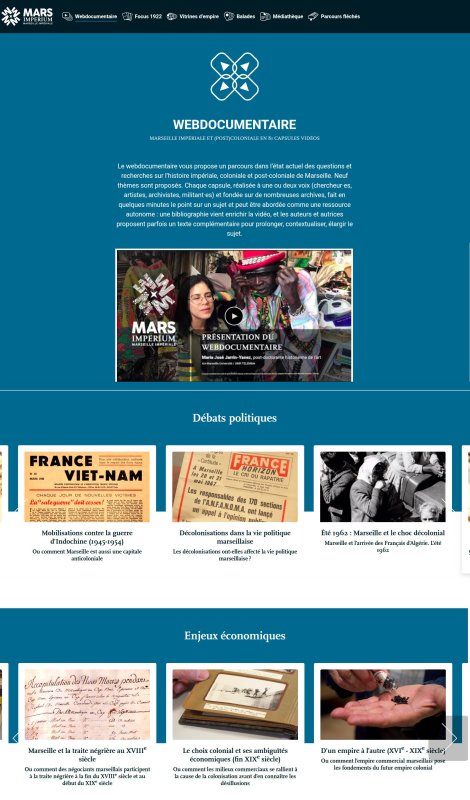
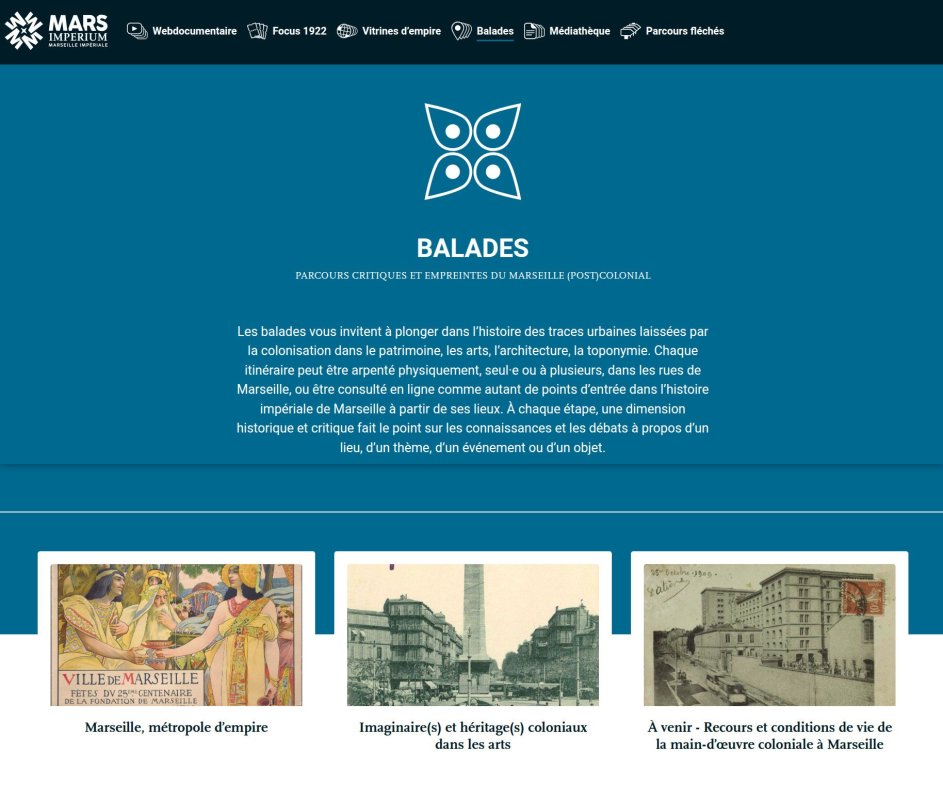
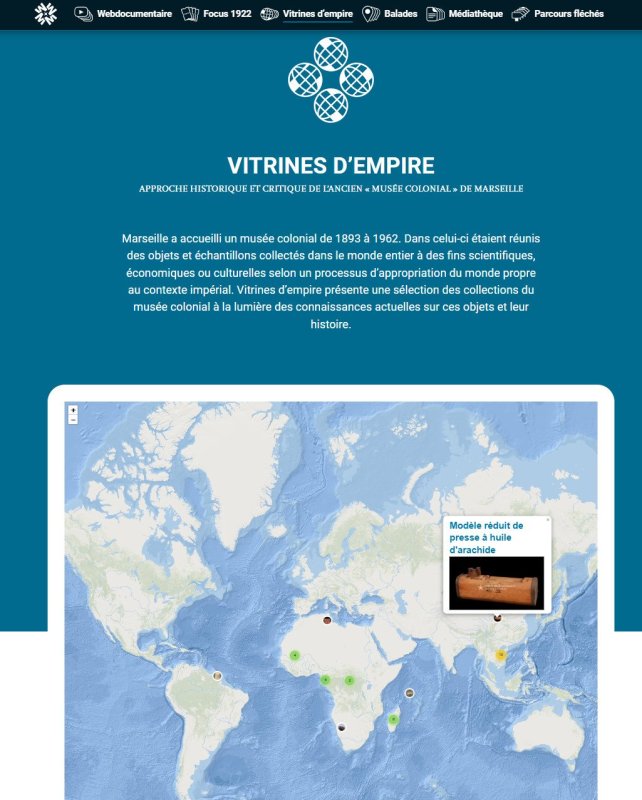
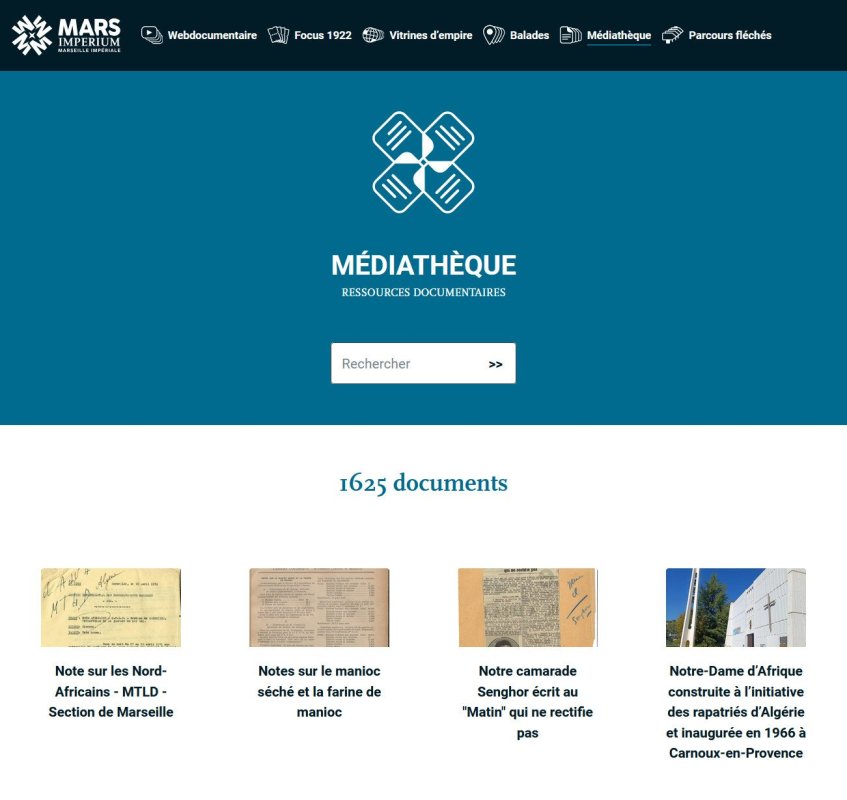
Another goal of this project is illustrated by the variety and nature of its productions. Mars Imperium was designed as a project for the general public, so that everyone could take part in this history, understand its current impacts, and access the research and archives about the colonisation. With this goal in mind we have created a collection of open access platforms via a single portal. Each of these platforms has a mission to report on the history and its traces according to a specific point of view and format. The web documentary is to take inventory of the established knowledge, research, and the remaining unanswered questions. The urban heritage walks allow one to dive into the history of this period. The film documentary focuses on the Colonial Exhibition of 1922. The digital showcase allows one to explore the history of the Colonial Museum of Marseille through its objects, and finally, the multimedia library displays the archives and sources that supported the research of this history.
Therefore, the project proposes several elements aimed to create a comprehensive history of the imperial fact in Marseille, but which can be explored independently from one another. For example, the web documentary is composed of 81 short videos which are grouped into 9 larger themes – political debates, economics issues, societies, knowledge and imaginaries, creations and cultures, narratives and media, museums and archives, urban imprints, and living memories. Each video, created by one or two voices (researchers, artists, archivists, activists) and supported by numerous archives, presents a review of the subject in a few minutes (“Fighting Against Imperialism from Marseille”, "Colonial Classes: Knowledge at the Service of Commerce (1892-1945)”, etc). Each video can be used as an independent resource with a bibliography and occasional suggestions made by the authors to expand upon the subject. Similarly, the itineraries of each urban heritage walk can be physically followed in the streets of Marseille, individually or in a group. But the walks can also be accessed online, with the locations serving as entry points into the imperial history of Marseille. We designed these elements to be seen, read and listened to by all types of public.
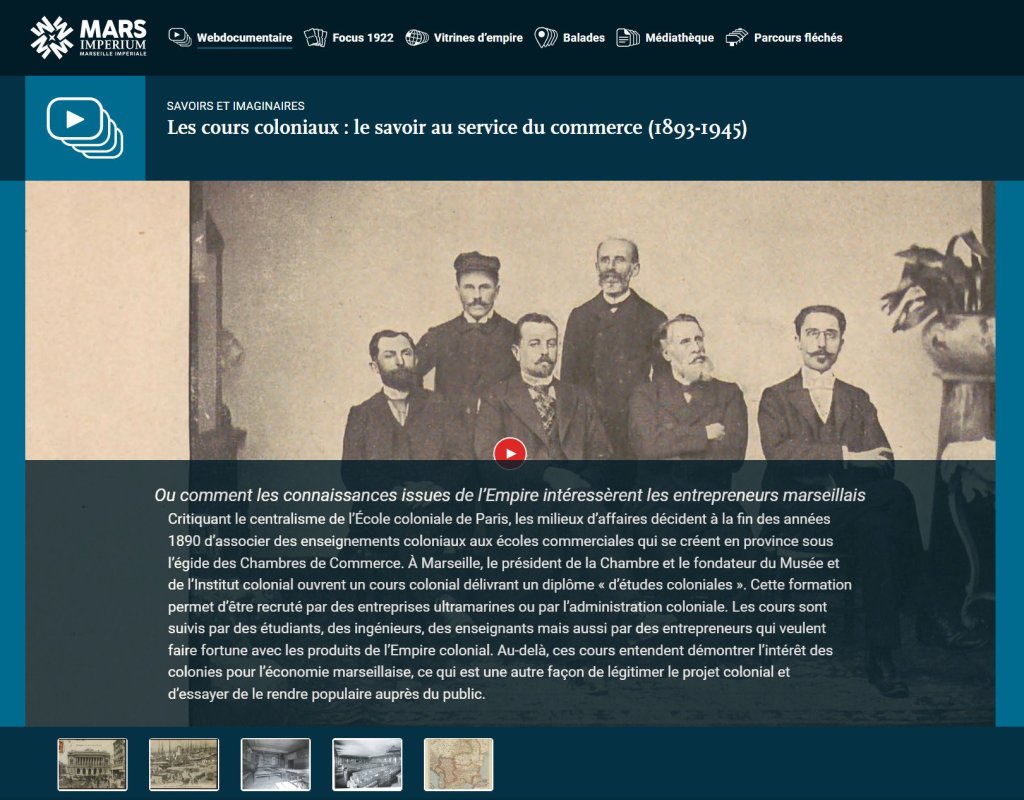
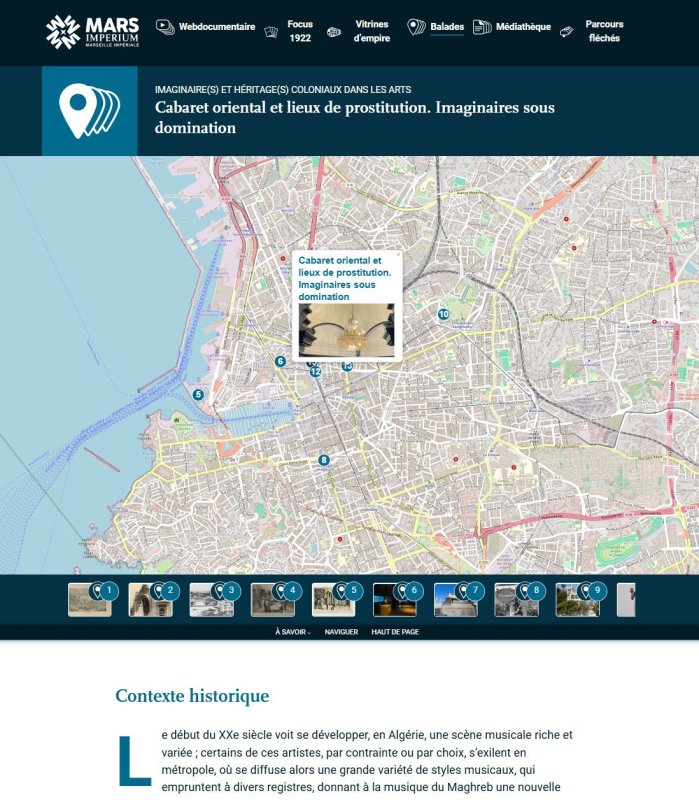
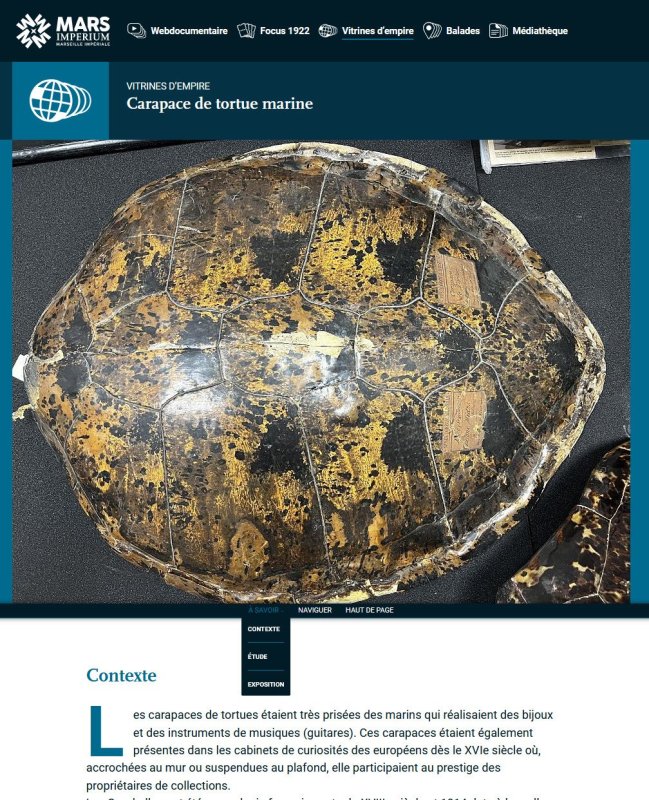
We also wished to suggest links between all of these elements as a way of demonstrating the plurality and interdependence between the themes discussed. Mars Imperium therefore offers multiple ways to circulate within its diverse content. Each platform of the website is constructed according to a navigation narrative or theme that responds to its research objective and allows one to follow a suggested thread. We also offer a transverse circulation of documents between all of the platforms via recommendations : on each webpage of every platform an algorithm suggests other resources that are connected thematically, spatially or temporarily to said webpage, drawing alternative paths within the core of this vast history.
Finally, the entirety of these platforms are assembled together in one shared portal : Mars Imperium. Therefore we suggest a navigation guided by several selected themes that are present throughout the entirety of the produced content. These theme groups were thought of based on topics that emerged throughout the project. They each provide a different perspective on imperial and colonial history. Some of the first thematic collections to be curated discuss topics such as: “Marseille, Melting Pot of Anticoloinal Mobilisations”, “Decolonization of Public Space and Tangible Heritage”, “Colonial Sciences”, “Slave Trade, Slavery, Indentured Servitude and Forced Labor”, “Women and Gender”, and “Racism and Xenophobia”.
Our aim here is to allow ourselves to take a step back from this abundant history and question it in the light of renewed and pressing issues in our public spaces. We aim to encourage new research to expand and enhance what has already been found. Not everything has been said, far from it.
Authors
-

CAVALLO Delphine
Valorisation et la diffusion numérique de la recherche en SHS, TELEMMe -

DAUMALIN Xavier
Historien, TELEMMe -

REGNARD Céline
Historienne, TELEMMe
Bibliography
(2005). Marseille porte Sud 1905-2005, La Découverte, Paris, 239 p., RIS, BibTeX.
(2013). “Histoire orale à Matonge (Bruxelles) : un miroir postcolonial”, Revue européenne des migrations internationales, 29(1), p. 133-155 (https://shs.cairn.info/revue-europeenne-des-migrations-internationales-2013-1-pa), RIS, BibTeX.
(1999). Imperial Cities: Landscape, Display and Identity, Manchester University Press, Manchester, 304 p. (https://books.google.fr/books/about/Imperial_Cities.html?id=4mlD25cnKTMC&red), RIS, BibTeX.
(2000). “Capital and Empire: Geographies of Imperial London”, GeoJournal, 51(1/2), p. 23-32, RIS, BibTeX.
(2002). Kolonialmetropole Berlin : eine Spurensuche, Berlin Edition, Berlin, 320 p., RIS, BibTeX.
(2007). Bordeaux colonial, 1850-1940, Éditions Sud Ouest, Bordeaux, 256 p., RIS, BibTeX.
(2006). Le Havre colonial de 1880 à 1960, Presses universitaires de Rouen et du Havre, Mont-Saint-Aignan, 680 p., doi: 10.4000/books.purh.7177 (https://books.openedition.org/purh/7177), RIS, BibTeX.
(2018). “Lisbon: reading the (post-)colonial city from the nineteenth to the twenty-first century”, Urban History, 46(2), p. 1-20 (https://www.cambridge.org/core/journals/urban-history/article/abs/lisbon-reading), RIS, BibTeX.
(1990). Migrance. Histoire des migrations à Marseille, Volume 4 tomes, Edisud, Éditions Jeanne Laffitte (réédition), Aix-en-Provence, RIS, BibTeX.
(2019). “Making Second Imperial Cities: Modern Ports, Colonial Connectivity, and Maritime Globalization”, Moderne Stadtgeschichte, p. 115-139, RIS, BibTeX.
How to cite
(2025). “About Mars Imperium”, Mars Imperium (https://marsimperium.org/a-propos-de-mars-imperium?lang=en), page consultée le 23 February 2025, RIS, BibTeX.